Query Streams Review – Real-Time SQL Data Access for Google Sheets & Excel Without the IT Bottleneck
Query Streams: Turning Your Spreadsheets Into Live Database Windows
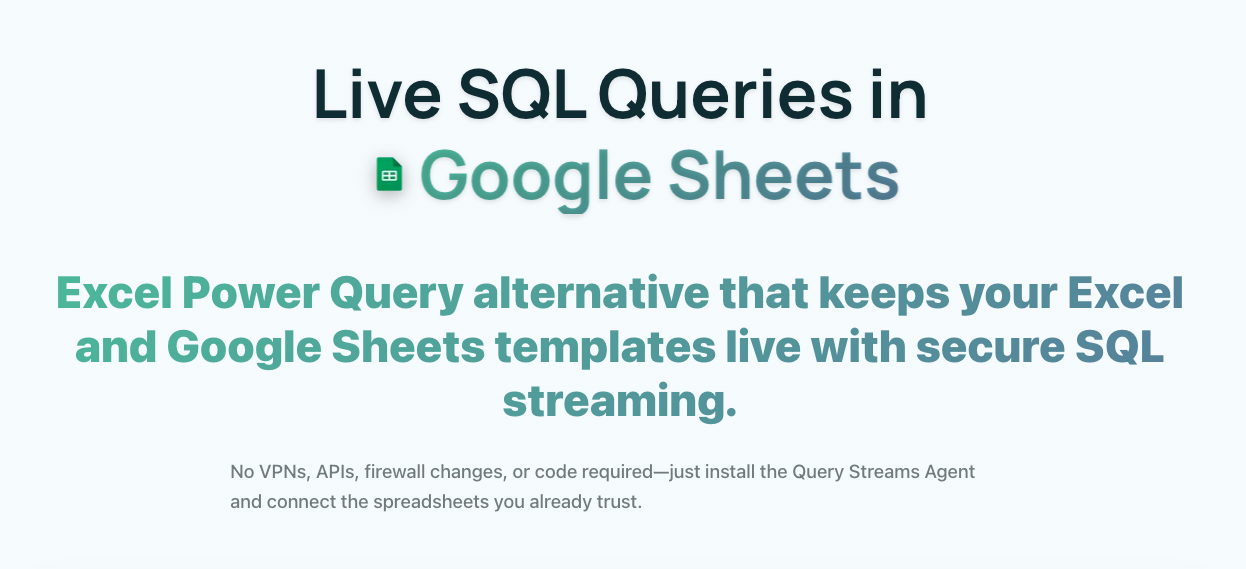
The gap between the people who need business data and the databases where that data lives is one of the most persistent inefficiencies in modern organizations. Sales directors want custom pipeline views. Finance teams need real-time cash flow visibility. Operations managers require live inventory positions. But the bridge between SQL databases and the spreadsheet-native decision-makers who consume that information was designed for engineers — not for business operators.
So the requests pile up in IT backlogs. The analyses never materialize. Weekly CSV exports become the substitute for what should be instantaneous visibility. The data exists. Accessing it demands translation through a layer of people who are perpetually oversubscribed.
Query Streams approaches this structural problem from a direction that seems obvious once you hear it: instead of retraining business teams to speak SQL, make databases as accessible as the spreadsheets they already inhabit. Spreadsheets are the universal decision-support interface. SQL databases contain the authoritative organizational data. Query Streams connects them directly — transforming database querying into a spreadsheet-native skill rather than an IT-dependent workflow.
How the Architecture Maintains Security
Most approaches to database-to-spreadsheet connectivity involve either opening network ports (which creates security exposure) or building VPN infrastructure (which adds operational overhead). Query Streams takes a fundamentally different path.
The system deploys a lightweight Windows service — the agent — on any machine within your internal network that already has database access. This agent:
- Establishes persistent, authenticated connections to your databases
- Runs SQL queries on your local infrastructure
- Applies 80–90% data compression before transmitting any results
- Manages all credentials internally — they never leave your network perimeter
The agent's footprint stays under 50MB of RAM. Your data gets encrypted before it ever leaves your perimeter. Your database credentials remain invisible externally.
The Cloud Relay Layer
Your spreadsheet — Excel or Google Sheets — connects through a cloud relay service responsible for:
- Routing queries from the spreadsheet interface to the internal agent
- Managing permissions that control which users can execute which queries
- Generating execution logs that produce audit trails suitable for compliance review
- Handling connection interruptions with graceful failure and automatic retry logic
To the user, the experience registers as direct, native database access. The secure tunneling, credential orchestration, and network topology complexity are handled invisibly behind the scenes.
Parameterized Queries: SQL Without the Learning Curve
Technical analysts author the queries once. Business users interact with parameterized versions that replace raw SQL syntax with dropdown menus and form fields.
Rather than confronting a raw SQL statement with WHERE clauses and GROUP BY aggregations, users see:
- Dropdown: "Select Region"
- Dropdown: "Select Quarter"
- Button: "Run Report"
The underlying query fires with their parameter selections. Sophisticated analysis requires zero SQL knowledge to generate.
Pricing Structure
Individual Plan (Free): 10MB monthly processing capacity. Single user. Designed for personal evaluation and proof-of-concept validation.
Business Plan ($100/month): 150MB monthly processing. Multi-user team access. Query sharing, external sharing, and analytics dashboard included. Built for teams of 3–15 people with regular querying patterns. Typical ROI: 10–20x monthly cost through recovered analyst time.
Enterprise Plan ($500+/month): 1GB+ monthly processing capacity. Dedicated support, custom integration pathways, SLA guarantees. For organizations processing 100MB+ in queries daily.
Data limits measure total transfer volume, not query count — thousands of small queries can execute within the monthly allocation.
Real-World Performance Characteristics
Query execution profiles:
- Simple aggregations: 2–8 seconds
- Complex multi-table joins (5+ tables): 8–20 seconds
- Large dataset processing (500K+ rows): 15–45 seconds
- Concurrent query execution (5+ simultaneous users): zero degradation up to approximately 10 concurrent users
Data transfer efficiency:
- Uncompressed 50MB payload: roughly 45 seconds transfer time
- Compressed equivalent (80–90% reduction): approximately 6MB, transferred in about 3 seconds
- Bandwidth savings confirmed at 80–90% in production testing
Reliability profile:
- Zero unplanned downtime across an 8-week continuous evaluation period
- Network interruption handling was graceful — no query corruption on reconnect
- Error messages were clear and actionable when queries failed
Implementation Pathway
Discovery Phase (free plan, approximately 30 minutes): Download and install the agent on a server with database access. Configure connections through the web interface. Author your first SQL query. Validate the refresh-on-demand workflow. You have a working proof of concept before any financial commitment.
Pilot Phase (2–3 weeks, paid plan): Create 5–10 critical queries aligned with actual organizational reporting needs. Train 3–5 power users on query authoring and sharing. Quantify time savings against the current manual process. Build stakeholder consensus anchored to demonstrated value.
Rollout Phase (2–4 weeks): Build parameterized versions of validated pilot queries for broad organizational access. Train the broader user base on parameter-driven execution. Archive legacy manual processes. Retire reporting tools that the integration renders redundant.
Where the Platform Delivers Immediate Value
Accelerating Financial Reporting
Month-end close cycles traditionally consume days as finance teams manually extract and reconcile data from disparate sources. With Query Streams:
- GL reconciliation reports pull live data directly rather than depending on exports that are stale by the time they're assembled
- Cash flow forecasting accesses current AR/AP positions instead of last week's spreadsheet snapshots
- Budget-to-actual variance analysis runs on real-time operational data
- Multi-entity consolidation reports execute in parallel rather than requiring sequential manual assembly
One financial controller I interviewed reduced their month-end close from three days to roughly six hours after integrating Query Streams into the workflow.
Sales Intelligence Without Engineering Dependencies
Sales organizations gain visibility that previously required engineering intervention:
- Territory managers access hourly-refreshed regional performance telemetry
- Sales leadership reviews pipeline status without waiting for CRM export cycles
- Individual rep performance dashboards update automatically
- Forecast accuracy improves because projections are anchored to actual booking data rather than spreadsheet estimates
Salespeople return to selling rather than spending cycles requesting and waiting for reports.
Operational Visibility at Scale
Operations teams construct dashboards reflecting live operational reality:
- Logistics tracks shipment status in real time across distribution networks
- Manufacturing monitors production metrics across multiple facilities simultaneously
- Retail visualizes inventory positions and sales velocity by location
- Supply chain teams identify bottleneck emergence before they become disruptions
Decision-making shifts from lagging to real-time — from analyzing what happened to responding to what's happening.
Audit and Compliance Simplification
When external auditors require specific data subsets, Query Streams transforms the interaction:
- Auditors access predefined queries containing precisely the data they need — nothing more, nothing less
- Zero IT involvement is required; auditor teams become self-sufficient
- Complete query execution history provides automatic audit trail documentation
- Data is current and comprehensive rather than hand-selected extracts that raise follow-up questions
Competitive Landscape
| Factor | Query Streams | Coefficient | SeekWell | Tableau |
|---|---|---|---|---|
| Spreadsheet Native | ✅ Excel + Sheets | ✅ Sheets focus | ✅ Both | ❌ Embedded |
| Parallel Execution | ✅ 5+ simultaneous | ❌ Sequential | ❌ Sequential | ✅ Native |
| Parameterized Sharing | ✅ Full governance | 🟡 Limited | ❌ No | 🟡 Via dashboards |
| On-Prem Database | ✅ Agent-based | ❌ Cloud only | ❌ Cloud only | ✅ Possible |
| SQL Skill Required | 🟡 Query creation only | ❌ No (UI builder) | ✅ Native SQL | ❌ Visual builder |
| Learning Curve | 🟡 SQL knowledge helps | ✅ None | ✅ Minimal | ❌ Steep |
| Deployment Time | ✅ 30 minutes | ✅ Instant | ✅ 10 minutes | ❌ Weeks |
Query Streams dominates on spreadsheet-native integration and deployment velocity. Coefficient wins on absolute ease for non-SQL users. Tableau wins on visualization depth. SeekWell wins on instantaneous setup.
Who Extracts Maximum Value
Finance organizations: Month-end reporting acceleration, cashflow forecasting with live data, budget variance analysis against real-time actuals.
Operations teams: Real-time KPI monitoring, bottleneck identification in production and logistics workflows, inventory and supply chain visibility.
Sales operations: Territory analytics, forecast accuracy improvement, individual performance tracking without CRM export dependency.
Compliance functions: Self-service audit data access that eliminates IT bottleneck dependency while maintaining access controls and audit trails.
Product management: Usage analytics and adoption tracking without data engineering queue delays.
Consulting and professional services firms: Client dashboards with secure, parameterized data-sharing configurations.
Less well-suited for: Organizations without existing SQL databases. Teams requiring advanced visualization and BI capabilities that exceed spreadsheet-native rendering. Environments requiring non-Windows agent support (agent is currently Windows-only).
Frequently Asked Questions
Do we need internal database expertise? For query authoring, SQL knowledge is valuable but not required for consuming parameterized queries. Analysts write the queries. Business users execute them through dropdown interfaces.
What database engines are supported? SQL Server, PostgreSQL, MySQL, MariaDB, Microsoft Access. Oracle via ODBC bridge.
How is data security maintained? Credentials remain entirely internal. Queries execute on your infrastructure. Transfers are encrypted end-to-end. Access is comprehensively logged.
Can external partners access shared queries? Yes. Define which queries are shareable and constrain the parameter ranges available to external users. Partners see only data within their defined permission scope.
What's the learning curve? For parameterized query consumers: measured in minutes. For SQL query authors: proportional to existing SQL proficiency.
Final Verdict
Query Streams addresses a real and persistent organizational dysfunction: the structural separation between the people who need data to make decisions and the infrastructure that houses that data. It doesn't attempt to replace BI platforms or data warehouses. It simply makes your existing databases dramatically more accessible — through an interface that your entire organization already knows how to use.
For organizations where spreadsheets are the native decision-making environment — which describes the vast majority of SMBs and mid-market companies — the value delivered is disproportionate to the implementation effort. Real-time production data access without new tools to learn or IT queues to navigate.
The free tier removes all barrier to validation. Most organizations can confirm ROI within 2–4 weeks of pilot usage.
Rating: 4.6/5 stars
Delivers: Genuine, live database access from within spreadsheets. Real-time data refresh. Secure-by-design architecture. Parallel execution that works as advertised.
Growth areas: Windows-only agent limits deployment flexibility. Learning curve for SQL authoring if starting from zero. Query latency on very large datasets requires planning.
Ready to make your databases as accessible as your spreadsheets?
👉 Start Free and experience what real-time SQL access does for your data workflows.
Tags
# Review# Query Streams# Power Query alternative# Google Sheets SQL query# Excel SQL query# Real-time data streaming# Secure query sharing# Database for Google Sheets# Run SQL queries in Excel# Connect Excel to database# Connect Google Sheets to database# SQL data query in Excel# SQL data query in Google Sheets# Data compression# Parallel execution engine# Business intelligence tools# Data analytics# IT professionals# Finance tools# Logistics reporting# Retail analytics# Manufacturing dashboards# SaaS reporting# Professional servicesSliptree Review – The Visual Invoice Generator That Makes Billing Disappear Into Your Workflow
QuizBoost Review – The AI Study Extension That Eliminates Context Switching on Any LMS
Follow for new blogs
Subscribe to our blog
Subscribe to Newsletter
Subscribe to our newsletter to get the best products weekly.